Azita MehrabiHand-knotted rugs and kilim cushions

Kilim cushions

Cushion covers cut from older flatweave.

A kilim that has worn too thin to lie on a floor still has sound cloth in it. The covers in this room are cut from that cloth, one at a time, backed in plain cotton and closed with a zip. Each is listed on its own, with its size, its insert size and the part of the kilim it was cut from.

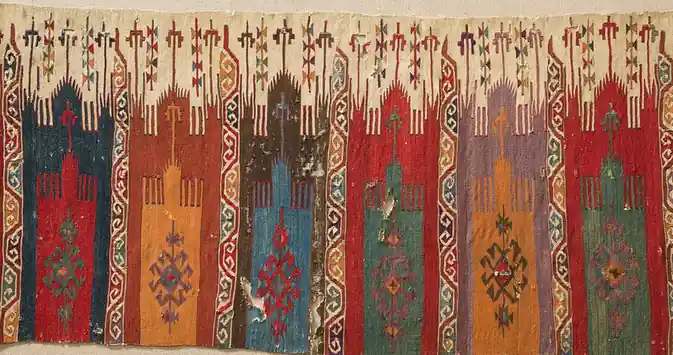
A flatweave of six tall niche panels in red, blue, green, orange and violet, with worn patches and small holes, laid on plain linen
A flatweave of six niche panels with worn patches and small holes. Sound cloth between the holes is what a cushion cover is cut from; the holes are why the piece is no longer a rug.

Where a cover comes from

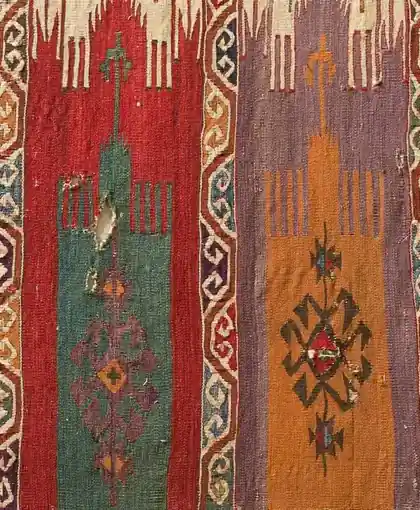
Two niche panels of a flatweave side by side, one red and green, one violet and orange, each with a lozenge at its centre
Two panels from one kilim, side by side. One would become one cover; the other, a second cover that is its neighbour and not its twin.

A flatweave has no pile. Its pattern is the weft itself, packed down over the warp, so the cloth is the same on both faces and it can be cut and hemmed like any woven fabric. That is what makes an old kilim useful long after it has stopped being a rug.

The cut is planned around the pattern, not around the holes. A cover is cut from the field where a motif can sit whole, from a border where the stripes can run straight along one edge, or from a medallion that will be centred on the face or set to one side. The listing names which of the three it is, and a photograph of the cover lies beside a photograph of the kilim it came from wherever we still have one.

What a cover will never have is a seam down its face. If a motif is too large to fit inside the cover's size it is cut off cleanly at the edge, and the listing says so, rather than being pieced from two parts of the kilim.

The kilims themselves are chosen for their cloth. A flatweave that has worn thin, that has lost its ends, or that has a hole through its field is the right starting point. A sound flatweave that could still be walked on is not cut; it is listed as a rug.

Backing, zip and insert

  • BackingPlain cotton, in a natural or a dark shade chosen to sit quietly behind the face. It is cut a little larger than the face, turned in, and sewn along all four edges. The backing carries no pattern, so the cover reads as the kilim and nothing else.
  • ZipAlong one edge, under a flap of the backing so it does not show from the front. The zip runs the full length of the edge, which makes the insert easy to get in and out for airing.
  • Insert sizeWritten on every listing. A cover holds its shape when the insert is a little larger than the cover itself, so the corners fill and the face pulls flat; the listing gives the insert size that does that for the cover in question. Inserts are not sold here.
  • FibreThe face is wool, or wool and cotton where the kilim's warp was cotton. The listing says which. Silk does not appear in flatweave covers from this room.
  • WearAny thin patch, any small hole that was too small to cut around, any place where a colour has bled. It is written in the same words as the wear line of a rug's note.

Why two covers from one rug differ

Two covers cut from one kilim are neighbours, not twins, and a listing that says pair means exactly that: two covers from the same piece of cloth, photographed side by side, with their differences written down.

The reasons they differ are the same reasons a hand-woven cloth is worth having. The dye lot changed part way along, so a red that is bright at one end of the kilim is brick at the other; that is abrash, and it will land differently on each cover. The weaver's hand tightened and loosened, so one motif sits a shade taller than its neighbour. The wear was uneven, so one cover carries a thin patch and the other does not. And the pattern drifts, so a lozenge that is centred on one cover sits a thumb's width off centre on the next.

If you want two covers that match, buy two from a mill. If you want two that belong together, a pair from one kilim is that, and the listing shows you both faces before you ask.

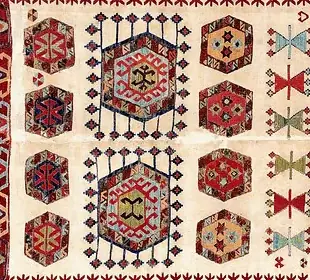
One hexagonal medallion from the field of a flatweave, in red, blue and ochre on cream
One medallion from the field of a flatweave. Centred on a cover it becomes the cover's whole face; set to one side it becomes a corner detail.

How a cover is listed

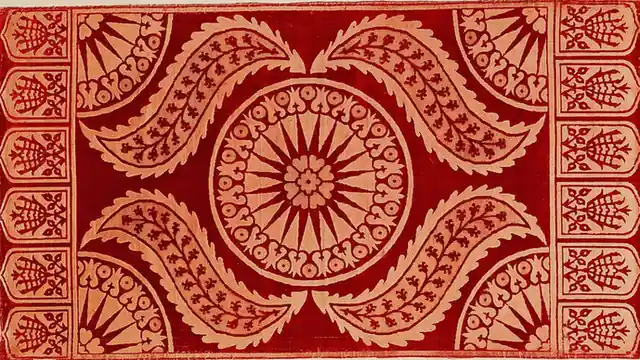
A cushion face in deep red and cream: a round medallion at the centre, curved leaves around it and a row of small arches down each end
A cushion face laid flat: a medallion at the centre, leaves curving around it, and a row of small arches down each end. The parts of a face are named the same way as the parts of a rug.

A cover is photographed flat, face up, in daylight, with its zip edge at the bottom of the frame. The listing then describes the face in the same words used for a rug, because a cushion face has the same parts: a field, a medallion if there is one, and an end or a border where the pattern changes.

The listing gives the cover's size across and down, measured with the cover empty and lying flat. It gives the insert that suits it. It names the part of the kilim the face was cut from. And it gives the wear, including anything on the back, since the back of a flatweave is a second face and is photographed as one.

The one thing the listing does not do is guess. A cover is not described as old, its kilim is not given a place of origin, and it is not called a collector's piece. It is a cushion cover, sold to be leant against, and it is described as one.

Living with one

A cover cut from an old flatweave wants the same handling the kilim did, which is to say very little.

  • Do not wash it.Dyes in old flatweave can run, and a wash also shrinks the cotton backing at a different rate from the wool face, which puckers the cover. Spot-clean dry, by blotting, and stop there.
  • Keep it out of direct sun.Sun fades wool unevenly, and a cover that sits in the same window every afternoon will end up two-toned. Turn it now and then, and swap it with another if it lives in the light.
  • Take the insert out to air it.The zip runs the full edge for this reason. An hour flat in shade, face down and then face up, is enough.
  • Expect the wear line to be true.A thin patch listed on the cover will stay a thin patch; it will not get worse in ordinary use, and it will not be repaired here, because the room repairs nothing.
Ask about a cover

Name the cover, or the colours you sit among.

You will get its size, its insert size, both faces in daylight, and a plain answer on whether it is still here.

Ask about a piece